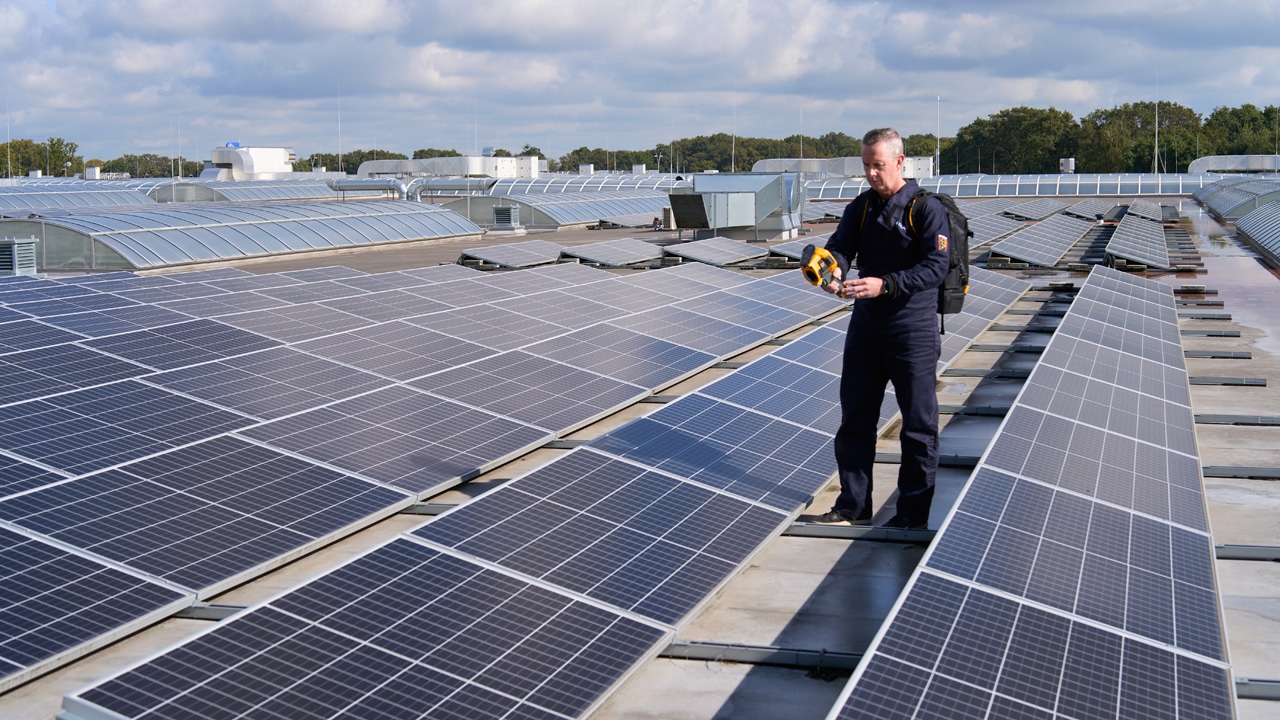
Growth targets for solar demand more knowledge in a market with limited experience. Fluke's easy-to-use instruments benefit all installation and maintenance professionals.
Countries around the world are driving initiatives to protect the planet and minimize the use of fossil fuels, thus increasing the number of installations of solar-powered systems. To be as productive and efficient as possible, technicians need the tools that are easiest to use, protect them, and save time and money.
The power generation capacity of solar PV systems is projected to quadruple between 2022 and 2026, increasing the need for more installation and maintenance technicians with various levels of experience and knowledge. The only way for these operators to work safely and efficiently, along with compliance with IEC/EN 62446-1, is for them to use instruments in the field that simplify the testing process and provide accurate, reliable data. and easy to transfer and analyze.
Over the next few years, the solar energy industry will need a lot of new people, such as electricians, project managers, technicians and others, and the instruments they use will have to offer them optimal levels of usability and functionality.
User experience and multifunctionality
The first requirement for test instruments is that they are intuitive to use in order to protect operators from problems that may arise when they have to interact with complex instruments and processes. At the same time, test instruments for solar energy must be capable of multitasking. Multifunctionality is paramount so that technicians do not have to carry multiple pieces of equipment with them in the field or change from one to another during the testing process. For example, technicians working with photovoltaic systems have to measure irradiance energy and take electrical readings, checking watts per square meter of solar irradiance and temperature, as well as orientation and tilt of solar panels.
Integrated for electrical check
The advantages of having a single solution are evident when measuring the IV curve trace, protective earth resistance, open circuit voltage (Voc), short circuit current (Isc), insulation resistance, polarity and inverter efficiency, as well as when checking diodes and surge protection devices. By using a multifunction solar tester together with an irradiance meter, both connected via Bluetooth, a technician can increase efficiency as data is collected and recorded in real time in the field.
Another fundamental requirement of any instrument intended for testing photovoltaic systems, especially when working on large or complex projects, is the possibility of importing the measurement data directly from the instrument to a PC, as it facilitates the management of the entire certification. and documentation related to the management of solar assets.
Consistent, easy-to-understand reporting is a must for those working on commissioning, installing, and maintaining solar-powered systems.
Innovation thinking about the safety of the technician
Finally, instruments such as solar clamp meters for current testing need to be as compact as possible as technicians often have to work in confined environments and with small combiner boxes where space is limited. Safety and efficiency are improved with the use of measuring instruments that incorporate fine and durable jaws, and with a probe suitable for extremely confined spaces.
“When we develop our instruments we always keep technician safety in mind, as well as productivity and time,” says Mark Bakker, Fluke Field Applications Engineer. “That's why Fluke's SMFT-1000 multifunction photovoltaic tester for solar installations up to 1000V DC has been designed to offer an easy-to-use, all-in-one solution. Similarly, efficiency and ease of handling have guided the design of our IRR1-SOL solar irradiance meter, 1587 FC Insulation Multimeter, and 1500 V 393 FC CAT III True RMS Clamp Meter (the only clamp CAT III 1500V fine jaw current meter with IP54 housing protection). The world is changing as we decrease our reliance on fossil fuels and it is vital that those who work in the solar energy sector enjoy the best possible opportunities to make the dream of global renewable energy a reality.”