Extended range with functional safety measures for speedometers, side mirrors and other vehicle systems
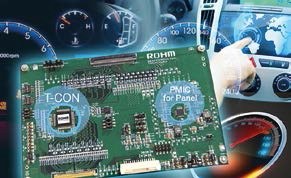
ROHM and LAPIS Semiconductor have announced the availability of chipsets designed for in-car LCD control, including the large, high-resolution monitors used for navigation and in the instrument cluster. In recent years, the level of adoption of LCD in vehicles for the instrument cluster, navigation, electronic mirrors and other systems has increased significantly; likewise the increasing number of applications has driven the demand for larger and higher resolution displays. To cover these needs, it is necessary to increase the number of control channels, which makes configuration and verification of system operation more difficult, which in turn increases the demand for chipset-based solutions. In addition, some applications such as electronic mirrors, whose malfunction can cause serious accidents, require functional safety. ROHM's new chipsets integrate a gamma correction IC, a timing controller (TCON), source driver, and gate driver for HD/FHD type displays (the highest resolution currently available on the market), as well as an IC power management IC (PMIC) that ensures optimal control. Each CI is designed to share information on an as-needed basis, thus achieving the level of reliability demanded by the automotive industry as it is the first time functional safety has been successfully added to display devices. They also offer LCD compatibility for side view mirrors and speedometers. Chipset optimization has also enabled ROHM to cover a wide variety of specifications while integrating a fault detection function into the timing controller to verify operation, thus enabling high-resolution LCD configuration. Availability: current
Main features
1. The first automotive chipsets to offer LCD functional safety
Each IC configured in the chipset integrates a function to select the expected failure mode. As a result, it is possible to additionally detect the failure of the screen, as well as confirm and provide information such as the input signals to the LCD as well as the degree of affectation/destruction of the LCD controller. he introduction of functional safety helps prevent serious accidents caused by malfunctioning monitors for the speedometer, side view mirrors and other systems. For example, the driver may not notice that the screen image for the side mirrors has frozen if no object has been detected at the time, posing the risk of serious injury if someone passes by. behind the car while it is moving. To prevent this from happening, ROHM offers functional security capable of detecting if the screen image has frozen. The PMIC incorporates double registration to detect abnormal operation and auto update function to allow recovery during abnormal operation, thus ensuring a high level of reliability against unforeseen influences such as noise.
2. High resolution HD/FHD LCD easy setup
ROHM's chipsets are designed to cover a wide variety of specifications, making it easy to set up high-resolution HD/FHD LCDs. In addition, the timing controller has a fault detection circuit to verify the operation of the chipset. The settings of each output in the PMIC can be changed simply by rewriting the value of the internal register. This reduces development resources and helps share board designs.
3. Extensive support available, including application cards
ROHM currently prepares manuals, reference designs, and application cards that facilitate chipset evaluation. Contact us for more information.
Terminology
functional safety
Functional security includes security measures (concepts for ensuring security) that minimize risk by adding functionality, such as monitoring and protective equipment. In the automotive market, functional safety minimizes risk to an acceptable level in order to prevent physical damage in the event of a malfunction due to electronic system failure. There is even an international standard for the functional safety of the car (ISO26262). Protection functions related to CIs are functions that ensure the safety of the CI itself by monitoring internal malfunction and damage.