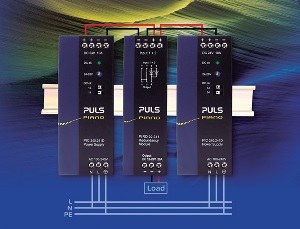
Intelligent control systems for industrial processes, communications, access control, etc., are becoming more important every day. It is necessary to ensure the safe and uninterrupted supply of these 12/24/48Vdc applications. At the same time, we become more aware of the importance of energy efficiency and improvement of the electronic equipment used. In order to meet these demands, MEAN WELL has evolved this range of products, developing new high-efficiency redundancy modules for DIN rail (DRDN20/40 series) and grid format (ERDN20/40 series). The DRDN20/40 and ERDN20/40 modules can be used both to complement power supplies and create redundant systems, and to parallelize sources when more power is required. In the simplest scenario, redundancy means that two power supplies are connected in parallel, each capable of handling the load on its own. This scheme is known as 1+1 redundancy. For higher output currents, N+1 redundant systems are used. In the example of a 200A load current, six 40A devices operate in redundant mode.
If one device fails, the remaining five power supplies can safely continue to power the 200A system. Fundamentally, redundant power supply systems consist of individual power supplies connected in parallel. As such sources normally do not have output decoupling diodes, these devices must be connected to redundancy modules. This allows the system to also remain operational even if a short circuit or failure occurs in one or more power supplies. The redundancy modules incorporate an independent DC-OK output per channel, which allows system status monitoring and fault detection.
The DRDN-20/40 and ERDN-20/40 modules have a voltage drop between 200-300mV
The diodes convert alternating current (AC) into direct current (DC) causing voltage drops of 500 to 800mV between input and output. Depending on the load current, the power losses can be very high and can cause heat problems. In the new DRDN20/40 and ERDN20/40 redundancy modules, the traditional diodes have been replaced by MOSFETs. In principle, diodes have been commonly used for power stages in power supplies, without this representing a significant advance. With external redundancy modules, we have to take into account various factors such as short circuits, backfeed loads and polarity reversal, which are not easy to solve. When the power supply is short-circuited due to load or wiring fault, no more voltage is available on the redundancy module. However, the inclusion of the MOSFETs in the module allows the short circuit current to flow with low power losses. If the supply fails in the MOSFETs, current will flow through the MOSFET diodes causing losses of up to 15 times more.
To avoid this situation, a circuit is used to generate a suitable voltage from the minimum residual voltage. In this way, when the power supplies are turned on, this process is essential as long as there is a short circuit or the input voltage has been reversed. The benefits of using these MOSFET redundancy modules are clear. Its low resistance causes less voltage drop than when diodes are used. With the renewed DRDN and ERDN series with 20-40A output current, there is only 200-300mV difference between input and output connectors. With traditional diodes, a voltage drop of 3000mV would occur in the same situation. The result of these losses is at least 10 times more and we would need to use powerful heatsinks for cooling. The DRDN and ERDN modules produce losses of 1,5W with an output current of 20-40A, they do not need a heatsink.
20/40A MOSFET redundancy module without heat sink
The DRDN20/40 and ERD20/40 redundancy modules have 12Vdc, 24Vdc and 48Vdc input voltage, with two 20/40A inputs (30/60A for 5 seconds) and one 20/40A output. The ERDN20 version also has a 5V voltage, something common in the market, but very interesting to be able to apply redundant power to critical loads such as microprocessors. We can install 1 + 1 or N + 1 redundant systems with output current power supplies up to 20/40A with a single redundancy module. Thanks to the low losses, heatsinks are not required in the DRDN20/40 modules for DIN rail, with the width of the device being only 32mm(DRDN20) and 55mm(DRDN40). The modules are short-circuit proof, protected against reverse polarity, and can operate at full power between -40°C and +80°C. With the integration of the DC-OK signal, we detect failures that may occur and thus be able to have more effective maintenance. Redundant systems can be configured for any type of application given the wide range of MEANWELL products in power supplies and these redundant modules: DRDN and ERDN.