News Summary:
- The new processors enable next-generation industrial and robotic solutions with up to twice the number of CPU cores and greater AI performance in the same compact space.
- From industrial automation to mobile robotics and medical imaging, embedded developers can accelerate AI deployments using AMD ROCm™, a proven open-source software stack for edge applications.
Factory automation, physical AI in mobile robotics, and other AI-driven edge applications are rapidly evolving and driving the need for computing platforms that deliver real-time AI processing, deterministic performance, and long-term reliability in always-on environments.
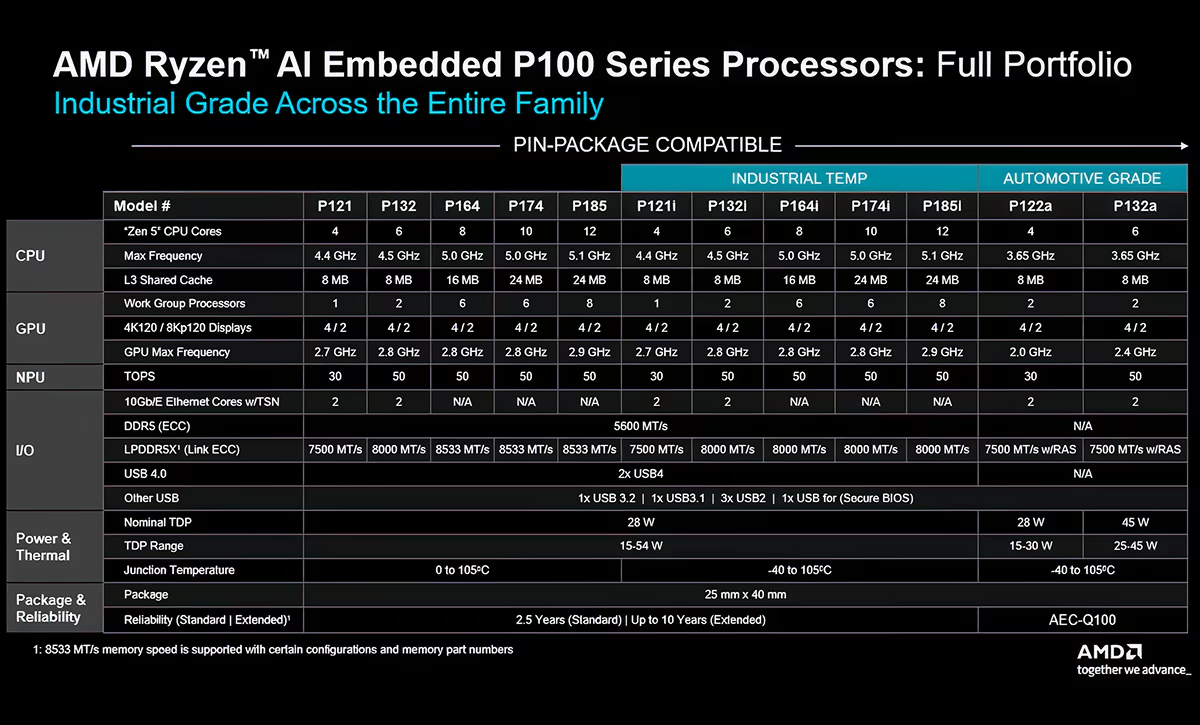
To meet these needs, AMD is expanding its AMD Ryzen™ AI Embedded P100 Series processor portfolioThe new processors offer up to twice the number of CPU cores, up to eight times the graphics processing capacity (GPU), and 36% more system teraoperations.
Scalable AI computing for demanding applications
The processors feature eight to twelve “Zen 5” cores, up to 80 system TOPS for physical AI acceleration, AMD RDNA™ 3.5 graphics for real-time visualization, and a neural processing unit (NPU) based on the AMD XDNA™ 2 architecture for low-latency, low-power AI inference, all on a single chip.
From industrial PCs for smart factories to autonomous robots and medical imaging devices, the new embedded x86 processors are optimized for the next generation of industrial AI and broader edge AI use cases. These include:
- Intelligent machine vision for industrial PCs: The new processors enable the integration of programmable logic controllers (PLCs), machine vision, and human-machine interfaces (HMIs) into a single industrial PC, while delivering the CPU performance required for real-time inspection and process optimization. The integrated GPU and NPU accelerate multi-camera vision and comprehensive HMI panels, while also enabling low-latency anomaly detection using models such as DeepSORT, RAFT-Stereo, CenterPoint, GDR-Net, PaDiM, and Llama 3.2-Vision.
- Physical AI for autonomous operations: In the case of mobile robots, the CPU handles navigation, motion control, and route planning, while the GPU processes multi-camera signals for spatial awareness, Visual SLAM, and advanced AI workloads such as vision-language-action (VLA) models. Unified memory between the CPU and GPU enables low latency for improved responsiveness. The NPU provides low-power, always-on inference for object detection and scene understanding using models such as YOLOv12 and MobileSAM.
- 3D Images of Health and Clinical Intelligence: Processors enable enhanced 3D imaging for ultrasound, endoscopes, tissue classification, and tumor detection in peripheral environments using models such as U-Net, nnU-Net, and MONAI. These processors accelerate image-to-report workflows with MedSigLIP and facilitate clinical reasoning and Q&A with Med-PaLM 2. Healthcare original equipment manufacturers (OEMs) can consolidate imaging, AI analysis, and reporting on a single, integrated, scalable, and long-lasting x86 platform.
Compared to the previous generation of AMD Ryzen™ Embedded 8000 Series, the P100 Series is expected to deliver up to 39% higher multi-threaded performance and a TOPS 2 total system up to 2,1 times higher. The new processors deliver exceptional AI performance per watt and support nearly twice as many virtual machines and large language models, such as Llama3.2-Vision 11B, as the existing P100 Series, enabling more advanced AI and mixed workloads.
ROCm software compatibility and virtualized reference stack
Compatibility with the AMD ROCm open software ecosystem brings a proven, open-source AI software stack to embedded applications. Developers can run standard AI frameworks with open-source compilers, runtime environments, and libraries, gaining immediate access to models compatible with the integration without having to rewrite code. At the program level, ROCm software utilizes the open-source Heterogeneous Computing Interface for Portability (HIP), decoupling GPU programming from hardware and eliminating vendor dependencies between the software stack and the hardware.
The tightly integrated CPU, GPU, and NPU architecture enables efficient workload partitioning and predictable latency in mixed workloads. Furthermore, the use of familiar software frameworks and stacks simplifies and optimizes development and deployment across a wide range of use cases. This level of integration allows for advanced computing and graphics capabilities without the need for additional external components, making it easier for original equipment manufacturers (OEMs) and system integrators to design scalable platforms.
AMD “Zen 5” CPU cores provide the isolation and performance headroom needed to consolidate multiple critical workloads onto a single platform with deterministic multitasking behavior. In addition, AMD offers a virtualized, compact, and vertically integrated reference stack for mixed-criticality industrial applications. Based on the Xen hypervisor, it runs Linux®, Windows®, Ubuntu®, and RTOS environments in isolated domains to deliver security, real-time performance, and flexibility. The result is a scalable and open architecture that simplifies design and accelerates the development of next-generation embedded systems.
Gaining strong industry support
The AMD Ryzen AI Embedded P100 processor, powered by Advantech, congatec, and Kontron, is currently available.
- Advantech is proud to announce a complete lineup powered by the AMD Ryzen™ AI Embedded P100 Scalable Processor portfolio. Featuring compute modules, single-board computers, edge AI, and intelligent systems, this portfolio leverages an enhanced embedded AI architecture to deliver highly efficient multitasking that drives the advancement of next-generation edge AI.
Aaron Su, vice president of the integrated IoT sector at Advantech. - With the launch of the AMD Ryzen AI Embedded P100 series, congatec expands its portfolio of compute modules for embedded and edge computing applications with a highly versatile platform. It allows customers to precisely tailor performance, power, and cost to the specific needs of their applications, offering four to twelve CPU cores and highly scalable GPU performance. This exceptional level of flexibility is essential as edge workloads diversify, from industrial automation to AI-accelerated systems.
Florian Drittenthaler, product line manager at congatec - The AMD Ryzen™ AI Embedded platform is revolutionary for industrial and AI-based applications at the edge. Our P100-based K4131-Px mITX processor will be equipped with quad- to twelve-core APUs, enabling us to offer customers a range of solutions that deliver high computing performance and AI acceleration in a compact form factor.
Thomas Stanik, senior sales and business development manager at Kontron
The AMD Ryzen™ AI Embedded P100 Series processors with eight to twelve cores are currently in the sampling phase, with production shipments expected to begin in July 2026. The P100 Series processors with four to six cores are currently in the sampling phase, with production expected to begin in the second quarter of 2026.